The word Gestalt comes from German and can be translated as “form,” “configuration,” or “organized structure.” More than a technical term, it reflects a key idea: our mind naturally organizes what we perceive into meaningful wholes, not isolated fragments.
Gestalt emerged in the early 20th century, when psychologists were exploring how humans perceive and interpret reality. At the time, many believed the mind could be understood by analyzing individual sensations and responses. Gestalt researchers challenged this, showing that perception is more than the sum of its parts.
The Whole is Greater Than Its Parts
A milestone came in 1912 when Max Wertheimer discovered the phenomenon of apparent motion: when two lights flash in quick succession, we perceive movement between them, not just two separate lights. This revealed that our brain actively creates new patterns from relationships between stimuli.
This insight led to the principles of Gestalt Psychology, famously summarized as: “The whole is different from the sum of its parts.” In other words, our perception organizes experiences into patterns, structures, and meanings automatically.
From Psychology to Therapy
In the 1940s, Fritz Perls, along with Laura Perls and Paul Goodman, developed Gestalt Therapy, inspired by Gestalt Psychology but also influenced by existentialism, phenomenology, and humanistic psychology.
In this psychological approach, the human being is seen as an integrated organism, constantly interacting with the environment. This approach prioritizes how people experience life, perceive the world, relate to others, and connect with their emotions.
Figure and Ground
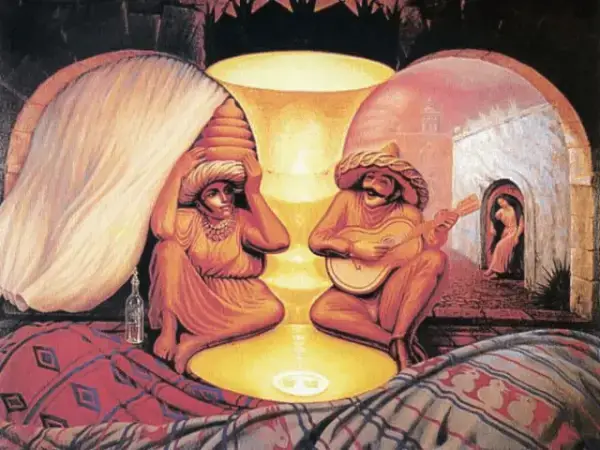
One of the core concepts is figure and ground. When observing a scene, our mind highlights a main focus (the figure) while everything else forms the background.
For example, in a busy restaurant, you can focus on the person you’re talking to, while conversations, clinking dishes, and music fade into the background. This focus can shift dynamically — a loud noise can instantly become the figure.
Figure-ground relationships apply beyond perception — they shape our thoughts, emotions, and awareness, highlighting what matters most in any given moment.
Awareness and Contact
Gestalt also emphasizes awareness (awareness), or the ability to notice what is happening in the present — thoughts, emotions, bodily sensations, and interactions with the world. Many emotional difficulties arise when we lose contact with our own experience, avoid feelings, or repeat unhelpful patterns.
Contact is another key concept. Healthy living requires the ability to connect with the world — with people, the environment, and oneself. When this connection is blocked, we may feel emptiness, confusion, or emotional distance. Gestalt therapy helps restore this capacity, allowing individuals to be fully present in their experiences.
Living Authentically
Gestalt Therapy is more than a technique — it’s a way of understanding human experience. It encourages presence, personal responsibility, and authenticity. By valuing direct experience and fostering awareness, individuals can better understand themselves, develop their inner resources, and navigate life creatively.
Each person is more than the sum of behaviors or symptoms — a unique, complex whole capable of growth and transformation. Gestalt Therapy invites us to explore ourselves with curiosity, presence, and authenticity, opening the door to deeper self-awareness and more meaningful relationships.